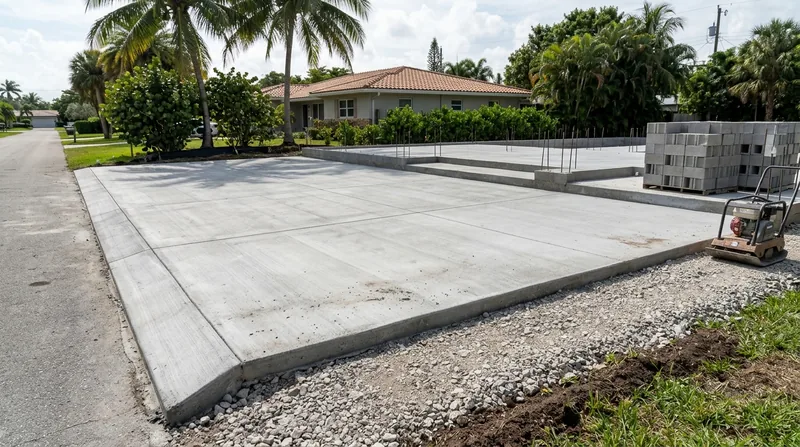




Fort Lauderdale's subtropical terrain sits on sand and porous oolitic limestone with a very high water table, making concrete slabs and foundations critical to the stability of homes across the city. From the narrow driveways under banyans in Sailboat Bend to the wide two-car garage pads in western subdivisions, a properly engineered slab prevents settling, cracking, and water intrusion that plague poorly compacted bases. The intense summer downpours, salt air near the beach, and year-round heat demand slabs built with the right thickness, steel reinforcement, and drainage from day one. Whether you're adding a room, building a new garage, or pouring a shed foundation in Coral Springs or Plantation, the foundation work determines whether your structure stays level and dry for decades or develops costly cracks within a few seasons. We pour engineered concrete slabs and footings with site-specific base preparation so your investment holds solid.
Why Concrete Slabs and Foundations Matter in Fort Lauderdale's High Water Table Environment
Fort Lauderdale sits on soft ground laced with canals and the New River, and the water table rises dramatically during king tides and summer storms. A slab poured on an inadequate base or without proper compaction will sink at the joints, crack along stress lines, and allow water to seep up through the concrete into your garage, addition, or storage structure. The limestone bedrock is porous, and poorly compacted fill or sand allows water migration and differential settlement. We engineer every slab with the right thickness, reinforcing steel, and a compacted granular base so it stays level and watertight for 20 years or more.
- We compact the subgrade to specification and add a gravel base course to distribute loads evenly and allow drainage.
- We specify and place reinforcing steel (rebar or wire mesh) to resist cracking from temperature change and settlement.
- We pour concrete at the correct thickness, typically 4 to 6 inches for residential garages and foundations, engineered for the load.
- We finish and slope the surface for drainage so water runs off rather than pooling and seeping into the slab.
- We cure the concrete properly so it reaches full strength and resists the salt air and UV exposure of South Florida.
A solid foundation keeps your structure dry, level, and safe from the settlement and water damage that are the dominant failure modes in Fort Lauderdale.
Key info: Fort Lauderdale's finger isles in Coral Ridge and Harbor Beach, and the western subdivisions toward Davie and Sunrise, have thousands of homes with garages and pool decks on slabs poured decades ago. Many of these slabs have settled or cracked because the base was not properly compacted or the slab was not reinforced. A new slab poured to current engineering standards will outlast the house. Check with the City of Fort Lauderdale building department for current setback and width requirements for your project.
How We Build Concrete Slabs and Foundations for Fort Lauderdale Homes
Every slab we pour starts with a site walk, soil assessment, and measurement of the water table depth and drainage conditions. Fort Lauderdale's sandy and mucky soil requires a different approach than inland Florida clay, so we design the base, thickness, and reinforcement for your specific lot. We work with local building permits and ensure the slab is placed at the correct elevation to stay above storm surge and seasonal flooding. The process takes planning, the right equipment, and concrete delivered at the right slump and strength for South Florida's heat and humidity.
- We obtain or coordinate the permit with the City of Fort Lauderdale and confirm setback, width, and elevation requirements.
- We excavate and grade the site, removing soft organic muck and replacing it with clean fill compacted in lifts.
- We place and compact a 4 to 6 inch gravel base course to distribute loads and allow drainage.
- We set up forms and stringlines so the slab is level and at the design elevation.
- We place reinforcing steel (rebar grid or wire mesh) at mid-depth to resist cracking.
- We order concrete from a local supplier and pour the slab in one day, finishing it to the correct slope and texture.
- We cure the concrete with moisture and shade for 7 to 10 days so it reaches full strength before traffic or loading.
The result is a solid, level foundation that will not settle or crack under the weight of your garage, addition, or shed, even as the water table fluctuates and hurricanes pass overhead.
Local example: A homeowner in Plantation needed a new foundation for a room addition to a 1970s CBS ranch. The original slab was 4 inches thick on an inadequate base, and the addition settled 1.5 inches over 10 years. We excavated the addition area, removed soft muck, compacted a proper gravel base, and poured a 5 inch slab with a rebar grid at 12 inch centers. The slab has remained level for over five years. See our work on concrete repair and resurfacing for similar stabilization projects.
Methods and Approaches to Concrete Slabs and Foundations
| Approach | Description | Best for |
|---|---|---|
| Monolithic slab | Slab and footing poured together in one pour, with the footing dug below grade and the slab above grade. | Garages, sheds, room additions on stable soil or with good drainage. |
| Thickened-edge slab | Slab with a thickened perimeter that acts as a footing, sitting on compacted soil or gravel base. | Light residential structures in Fort Lauderdale where soil is stable and water table is managed. |
| Floating slab with perimeter insulation | Slab poured on a well-compacted gravel base with foam insulation at the perimeter to reduce edge heave and settlement. | Conditioned spaces (garages, workshops) where temperature control is desired and base is soft or mucky. |
| Reinforced slab with rebar grid | Slab with a full grid of rebar at 12 or 18 inch centers, tied and suspended at mid-depth, for high-load or high-settlement-risk sites. | Additions to older homes, pool decks, high-traffic areas, and sites with poor or variable soil. |
| Post-tensioned slab | Slab with high-strength steel cables or strands tensioned after the concrete cures, creating internal compression. | Large spans, poor soil, or high-load applications where conventional reinforcement is not enough. |
Concrete Slabs and Foundations Cost in Fort Lauderdale: What to Expect
Concrete slabs and foundations in Fort Lauderdale start at $5 per square foot for a basic 4 inch slab on a well-prepared gravel base in a straightforward residential garage or shed application. The price moves up based on slab thickness (5 or 6 inches for heavier loads or softer soil), reinforcing steel (wire mesh or rebar grid), site preparation complexity, and the cost of removing and replacing soft or mucky soil. A slab poured in Coral Springs or Sunrise on stable sand may cost less than one in Sailboat Bend or Victoria Park where the soil is mixed and the water table is higher. If your site requires soil import, extensive compaction, or drainage work, the cost will reflect those labor-intensive steps. We recommend getting two or three estimates so you understand what base preparation, reinforcement, and finishing are included at each price point. Visit our pricing page for more detailed breakdowns and examples, or call us at (754) 218-2497 for a free, no-obligation estimate tailored to your site and scope.
What to Look for When Hiring a Concrete Contractor Near Fort Lauderdale
When you're ready to hire a contractor for concrete slabs and foundations, focus on proven experience, honest communication, and protection for your property. Fort Lauderdale's unique soil, water table, and permit environment demand a contractor who understands the local challenges and builds slabs that last. Ask for references from recent jobs in your neighborhood, check their insurance coverage, and get the estimate in writing so you know exactly what work and materials are included. Many homeowners in Pompano Beach, Davie, and Plantation have had bad experiences with contractors who cut corners on base preparation or used inadequate reinforcement, only to see the slab settle or crack within a year. A legitimate contractor will carry general liability insurance and workers compensation insurance, provide a certificate of insurance on request, and explain how they'll handle permits and site access. Ask about HOA requirements and whether the work will need approval from your community before we begin. Call Fort Lauderdale Concrete for a free estimate, and we'll walk you through the process step by step.
Concrete Slabs & Foundations in Fort Lauderdale: Pricing Guide
| Service | Price | Details |
|---|---|---|
| Residential garage slab (4 inches, wire mesh) | Starting at $5/sq ft | Includes gravel base, compaction, wire mesh reinforcement, and finish for standard garage or shed foundation |
| Thickened slab with rebar (5-6 inches) | Starting at $6.50/sq ft | Rebar grid reinforcement, thickened perimeter footing, and proper slope for drainage in challenging soil or high-load areas |
| Site prep with soil import and compaction | Starting at $3/sq yd | Removal of soft muck or organic material, gravel base course, and compaction to specification before slab pour |
| Large or complex foundation (post-tensioned, engineered design) | On estimate | Requires site visit, soil testing, engineer design review, and detailed scope assessment before pricing is finalized |
| Travel and site visit | Included | No extra charge for travel within Fort Lauderdale and surrounding service areas including Pompano Beach, Coral Springs, and Davie |
| Free estimate | Free | Response within 24 hours at (754) 218-2497, includes site assessment, measurement, and written proposal with no obligation to book |
Indicative pricing, the exact cost depends on square footage, finish, and site access. Free personalized estimate within 24h at (754) 218-2497.


